scale(1.3637)'%3E%3Cg clip-path='url(%23cb)'%3E%3Crect x='0' y='0' width='1024' height='1024' fill='url(%23pg)'%3E%3C/rect%3E%3Cg clip-path='url(%23cf)'%3E%3Crect x='0' y='0' width='1024' height='1024' fill='url(%23fg)'%3E%3C/rect%3E%3C/g%3E%3C/g%3E%3C/g%3E%3C/svg%3E)
Equation and table source in Source viewEquation and table source
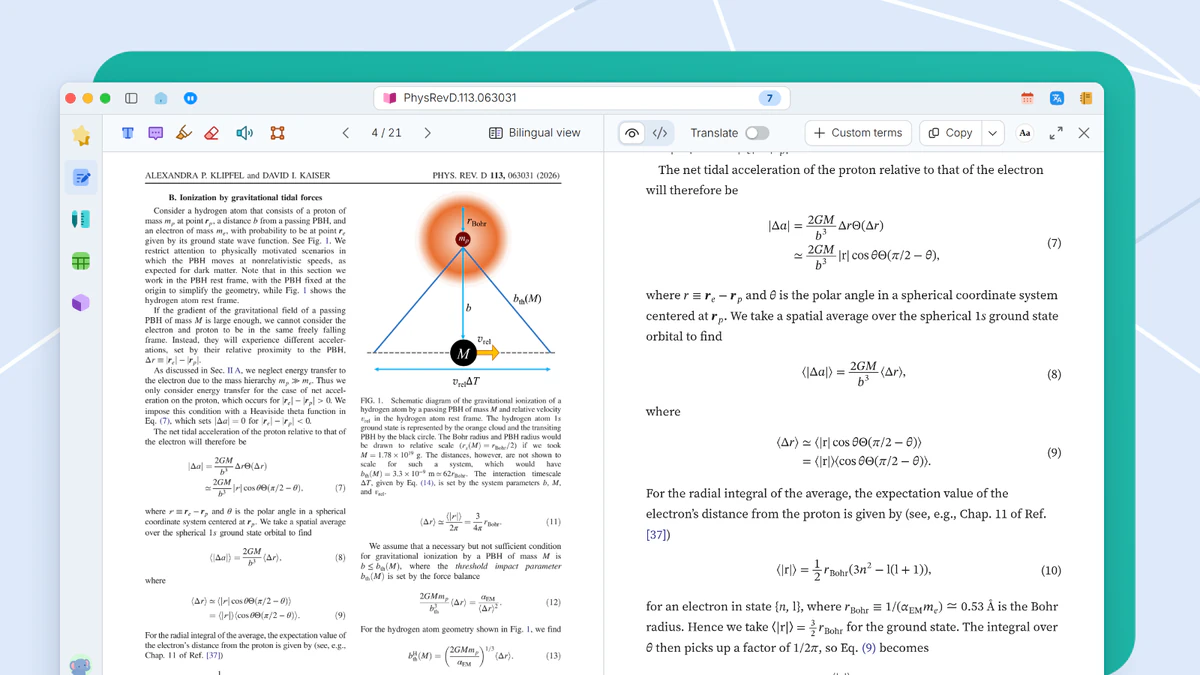
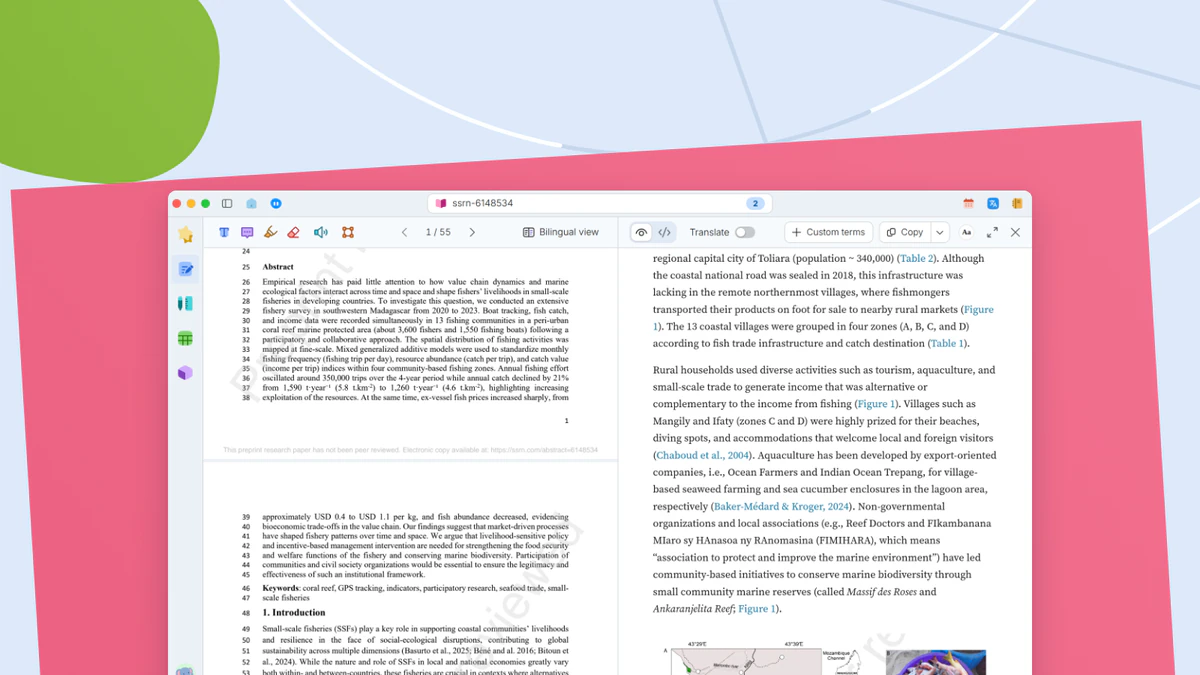
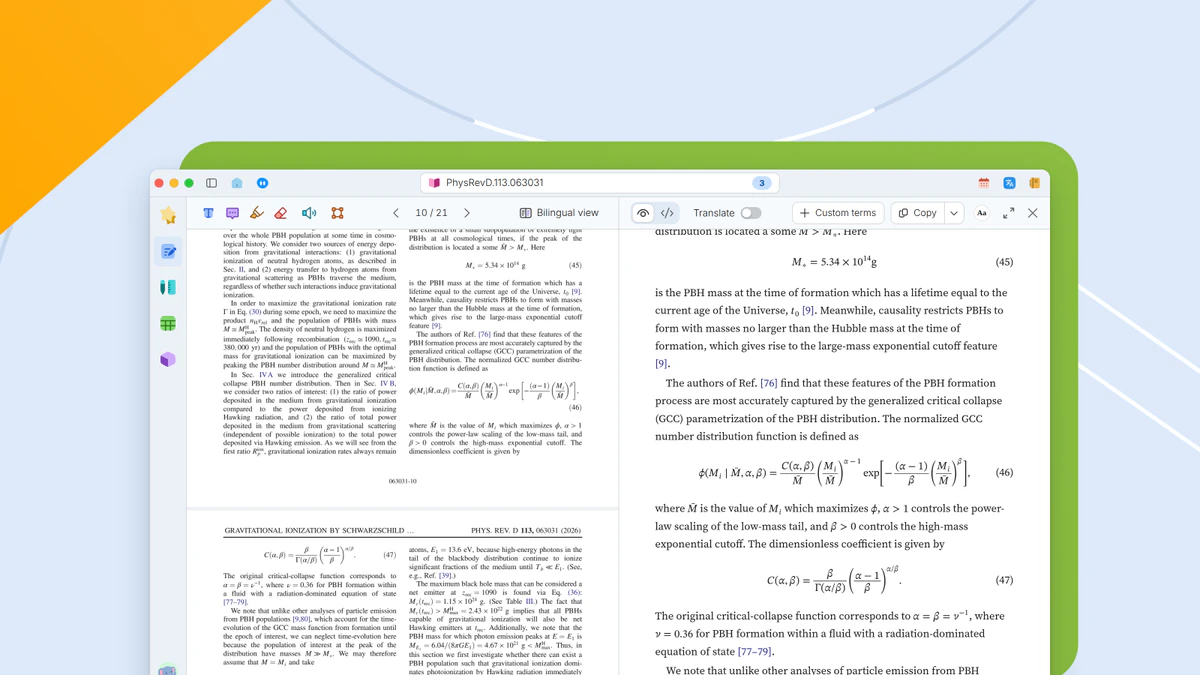
PDF on the left, Markdown source on the right. Equations as TeX and tables as Markdown tables, ready to copy or export.PDF beside Markdown source, ready to copy or export.

The source view shows the reflowed text as Markdown source, next to the PDF. Equations and tables can be copied from it instead of retyped.
When it helps
A paper has a table and several equations that belong in your own draft. Retyping them from the PDF invites misplaced numbers, the equations have to be keyed in again, and checking takes longer than typing.
- Equation and table source you want straight from a paper
- Reflowed text you need to check against the PDF
- A whole paper as Markdown or LaTeX
In this guide
Headings and equations in source
Click Source in the View group on the Home tab. The PDF is on the left and the Markdown source on the right. Two icons on the reading bar switch views. Headings start with #. Display equations sit between $$ and inline ones between $, in LaTeX. Copy them into your own manuscript.
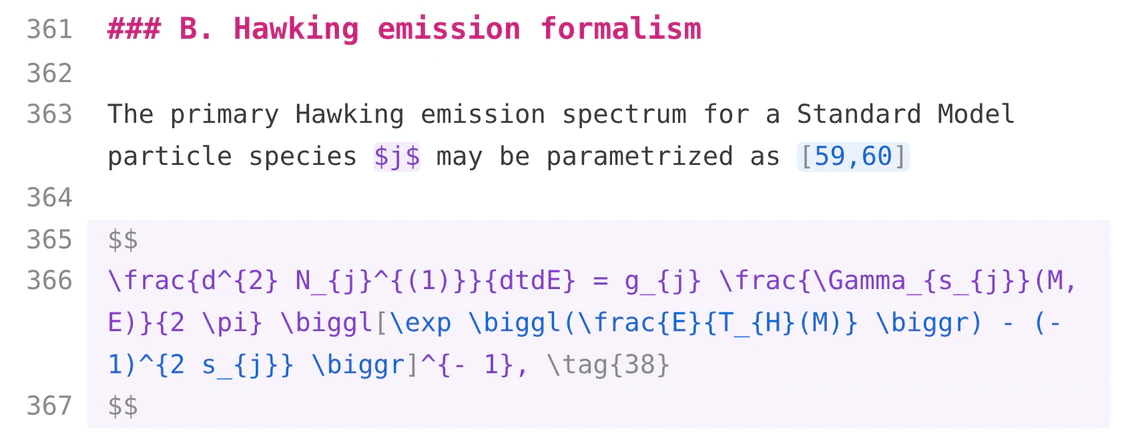
Display options
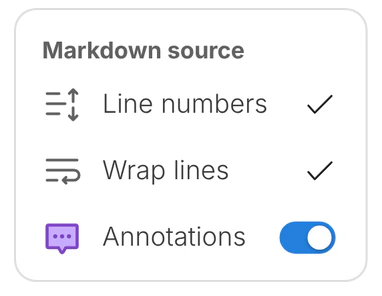
View options turns Line numbers and Wrap lines on or off. With an annotated PDF, the Annotations switch decides whether they are written into the source.
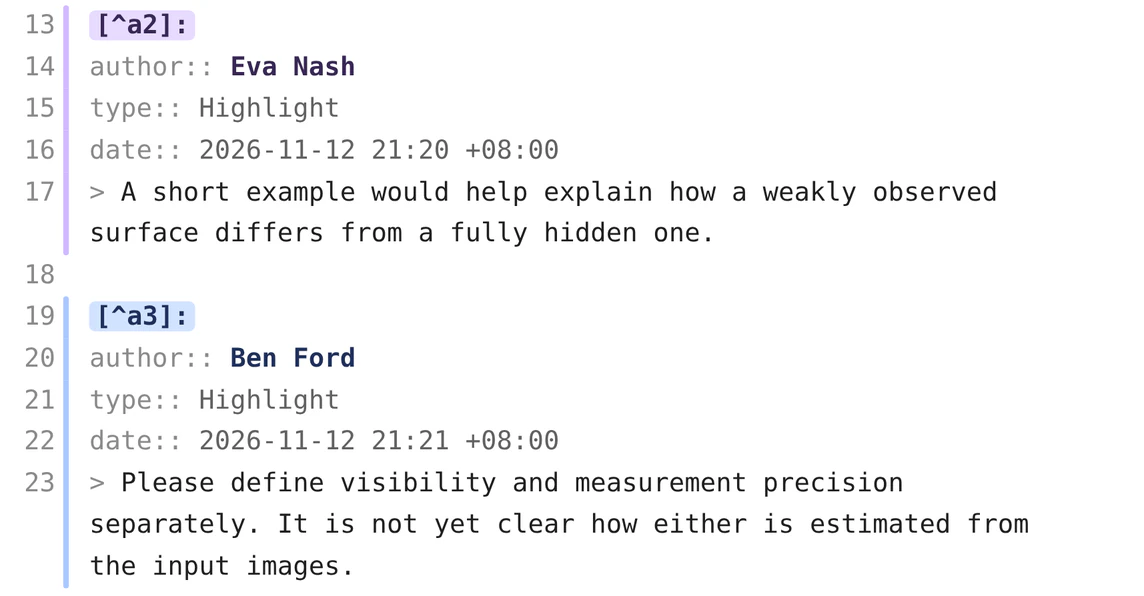
Annotations in the source
Highlighted text is written as {==text==} with a footnote number. The footnote records the annotator, type, date and comment.
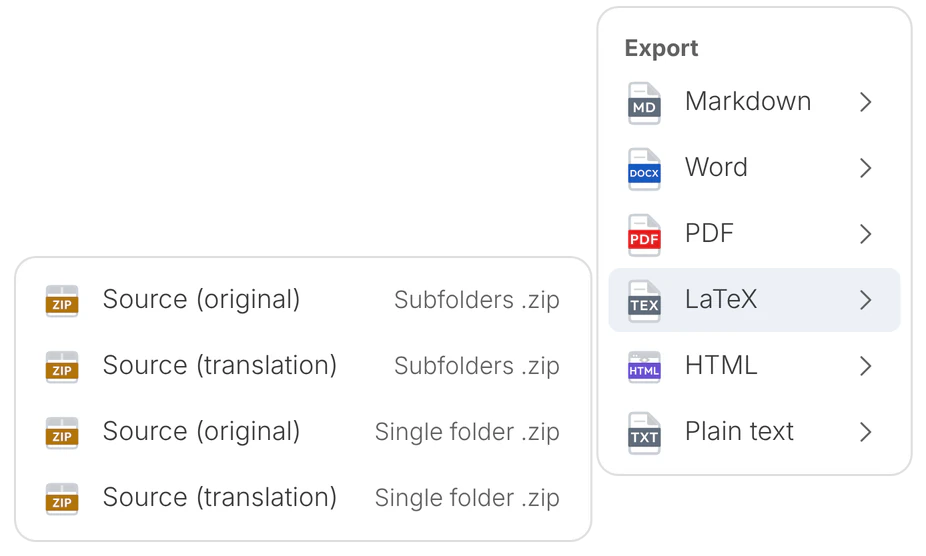
Copying and export
Copy puts the whole Markdown on the clipboard. The arrow next to it opens Export, with Markdown, LaTeX, Word, PDF, HTML and plain text.
Source of the translation
With Translate on, the translation has its own Markdown source. Equations, code and references stay as they are. Source (translation) exports it.
1# 史瓦西原初黑洞的引力电离2 3**Authors:** Alexandra P. Klipfel, David I. Kaiser4 5## 摘要6 7一般认为原初黑洞(PBH)是在极早期宇宙中由过密区坍缩形成的。在小行星质量范围内的 PBH $10^{17} g \lesssim M \lesssim 10^{23} g$ 可能构成当今暗物质的全部或大部分,但由于其 Hawking 发射率较低且 Schwarzschild 半径小于微米,因此尤为难以探测。本文探讨 PBH 的引力场所产生的陡峭梯度是否能生成足以破坏原子和原子核的潮汐力。此类现象可能会产生新的可观测现象,从而能够独特地区分 PBH 与具有相同质量的宏观物体。首先考虑周围中性氢的引力电离,并评估探测电离原子复合过程中产生的光子辐射的前景。在当前时期,这种效应将被 Hawking 辐射所淹没,对于处于小行星质量范围上限的 PBH 而言,本身也难以探测。随后,考虑了在 $z \simeq 1090$ 处复合过程刚结束后中性氢所受到的引力电离及其加热效应,并确定一大类典型质量为 $5 \times 10^{21} g \lesssim M \lesssim 10^{23} g$ 的 PBH 分布,在这些分布中,引力相互作用应是介质中主要的能量沉积形式。还确定了这样一种条件:在此条件下,来自过境 PBH 的潮汐力能够克服强核力,其方式或是解离氘核(这在宇宙大爆炸核合成过程中具有相关性),或是引发重核裂变。可以发现,对于质量为 $10^{14} g \lesssim M \lesssim 10^{16}$ 克的 PBH,氘核的引力解离作用在速率上超过了由 Hawking 辐射引起的光解离作用。此外,还发现了通过潮汐形变导致重核发生引力诱发裂变的现象。What you get
Equations and tables sit beside the PDF as source, ready to copy or export once checked.